The Korean War Monument (Photo by Hyemin Lee)
The War Memorial of Korea is hands down my favorite destination. If you’re a U.S. military member, a member of the UN forces stationed in Korea or simply a history buff, mark it as an absolute must-visit spot!
In South Korea, June serves as the month of honoring and commemorating patriots and veterans who were dedicated to protecting the country. Specifically, June 6th is Memorial Day, a public holiday to pay tribute to those who sacrificed their lives for the country’s freedom. The War Memorial of Korea is one of the most insightful places to learn about the Korean War, offering a powerful and accessible window into the nation’s significant history, completely free of charge.
The museum and memorial pay tribute to the veterans and those lost protecting the nation during the Korean War. As you wander through, you’ll witness heartfelt expressions of gratitude not only towards the Republic of Korea forces but also towards the UN forces who bravely defended Korea during the war.
Though Korea still remains a divided nation, many Koreans continue to strive for peace, a theme you’ll see throughout the museum.
.jpg/alternates/LANDSCAPE_910/0-1.%20View%201.jpg)
The War Memorial of Korea (Photo by Hyemin Lee)
5 NOTABLE OUTDOOR EXHIBITS
1.Statue of Brothers
Imagine the intense emotions of two brothers reunited as enemies on the chaotic battlefield of the Korean War. This statue was inspired by a true story of a Korean War veteran and shows the tragedy of the divided nation. The statue of the brothers embracing each other, symbolizes Korea’s collective aspirations for reconciliation, love, and reunification.
.jpg/alternates/LANDSCAPE_910/2-1.%20The%20Statue%20of%20Brothers%202.jpg)
The Statue of Brothers (Photo by Hyemin Lee)
2.Korean War Monument
As you enter the museum area, you will be overwhelmed by the massive and magnificent sculptures. They serve as a reminder that the pain of the Korean War should never be forgotten and of the hope for future peace and reunification.
The Korean War Monument (Photo by Hyemin Lee)
3.Monuments for UN Forces
They are established to express gratitude to the 22 countries that participated in the Korean War and commemorate the fallen soldiers. On the opposite side, there are flags of the ROK military branches’ units that fought in the Korean War.
.jpg/alternates/LANDSCAPE_910/2-3.-Monuments-for-the-UN-Forces-3.jpg)
Monuments for UN Forces (Photo by Hyemin Lee)
4.Open-air exhibition area
You will be delighted to explore this vast field filled with a fascinating collection of over 70 large-scale weapons that were used during and after the Korean War. This area is renowned as the museum’s largest photo zone, making it the perfect spot for both children and adults to enjoy.
.jpg/alternates/LANDSCAPE_910/2-4.-Open-air-Exhibition-Area-1.jpg)
Open-air exhibition area (Photo by Hyemin Lee)
5.Exhibition ROK’s PKM-357 Chamsuri
When you step into the model vessel, you will travel back to the intense moments of the Second Yeonpyeong Naval Battle in 2002, triggered by a preemptive attack from North Korea. The battle led to the sinking of the PKM Chamsuri-357, resulting in the death of six and injury of 18. It serves as a reminder of the ongoing conflicts and the fact that the Korean War has not officially ended.
.jpg/alternates/LANDSCAPE_910/2-5.%20The%20Exhibition%20of%20the%20ROKS%20PKM-357%20Chamsuri%201.jpg)
The Exhibition of the ROKS PKM-357 Chamsuri (Photo by Hyemin Lee)
INDOOR EXHIBITION HALLS
Korean War Rooms
Exploring the Korean War Rooms, you can learn in detail about the Korean War, including its historical background and significant events in chronological order. Also, you can see how UN forces aided and fought alongside ROK. This will help you catch a glimpse of the beginning of the ROK-US alliance and the UN Command.
-(3).jpg/alternates/LANDSCAPE_910/3-0.Indoor%20exhibition%203%203.jpg)
Indoor exhibition (Photo by Hyemin Lee)
KEY EVENTS
1. Illegal invasion of South Korea
North Korea, supported by the Soviet Union and China, invaded South Korea on June 25, 1950, and overpowered the South Korean military, occupying Seoul in three days. The NK forces, armed with strong weapons and tanks, recklessly broke through the 38th parallel to nearly Busan.
• Battle of Nakdsong River: The river was technically the final defense line as the South Korean government was driven from Seoul to Busan. The only hope was for UN forces to join the war and fight alongside ROK. Countless South Koreans including the ROK forces, young students around 13 to 15 years old with no prior combat experience, and civilians died to defend the area. Soon, UN forces joined the battle.
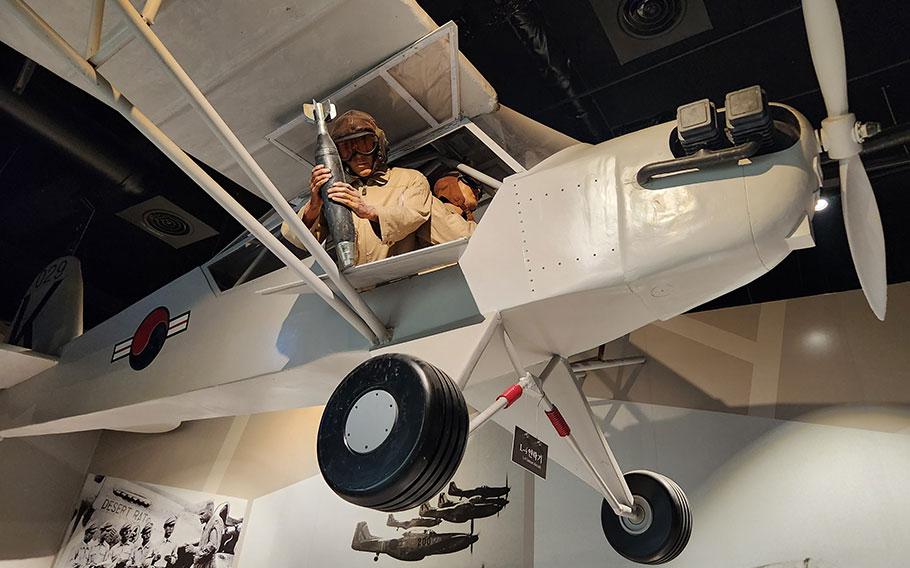
Invasion to South Korea. (Photo by Hyemin Lee)
2. UN Forces march north
Through a resolution adopted by the UN Security Council on June 27, 1950, UN member countries were urged to provide essential aid to the ROK. With the participation of UN forces and the success of Operation Chromite, the tide of the war was a complete reversal. By October 1950, North Korea was almost fully occupied by UN forces, leaving only a small portion of their territory. The ROK government under President Syngman Rhee was filled with excitement and believed that reunification was within reach.
• Operation Chromite: On Sept. 15, 1950, General MacArthur successfully led UN forces of 75,000 troops to land in Incheon. The UN forces subsequently recaptured Seoul and other territory. This was the greatest turning point in the Korean War. To this day, General MacArthur is still remembered as the ultimate hero of the Korean War.
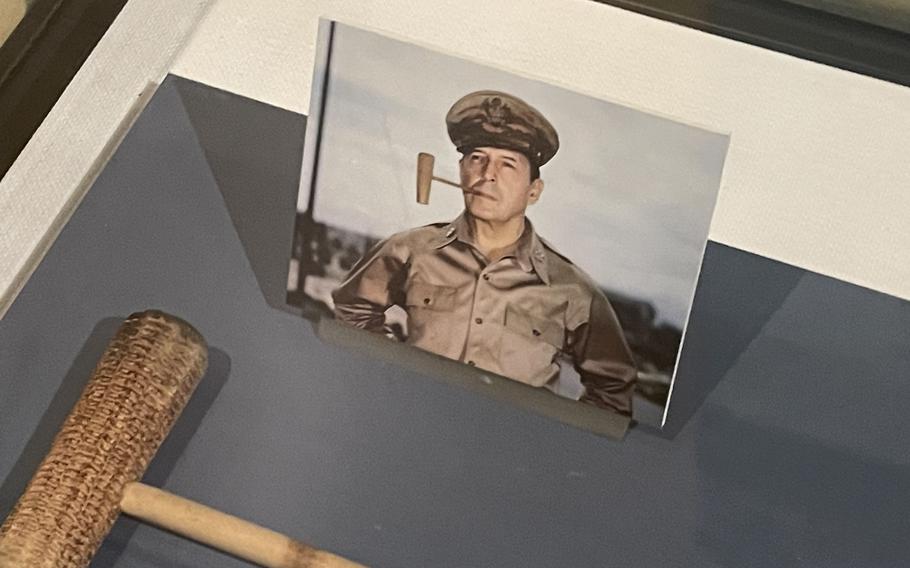
Operation Chromite (Photo by Hyemin Lee)
3. Chinese Forces and a war of attrition
At the very moment when the prospect of reunification seemed close, Mao Zedong, after gaining the upper hand in China, sent troops to assist North Korea, a fellow communist regime. The Chinese forces, with tactics such as human wave attacks, shifted the overall situation of the war again. The UN forces launched a full-scale counterattack. From that point, the war transformed into a brutal war of attrition with no gain for either side.
4.Truce talks and the Korea-US Mutual Defense Treaty
Amid the ongoing war of attrition for nearly three years, both sides grew significantly weary. The Korean War was finally halted with the signing of an armistice on July 27, 1953. Koreans who had hoped for reunification were greatly disappointed. Also, the ROK government had great concerns about the future after the war. As a result, South Korea entered into the Korea-U.S. Mutual Defense Treaty, which provides a war deterrent against further aggression from the North.
ROK Armed Forces Rooms
In these exhibition rooms, you will gain comprehensive understanding of how ROK forces have evolved after the Korean War. They also highlight the history of ROK forces participating in UN peacekeeping activities in various countries. It shows the transformation of this country from the one that received aid, to a nation that now provides aid to others.
.jpg/alternates/LANDSCAPE_910/4-1.%20ROK%20armed%20forces%20rooms%203.jpg)
ROK armed forces rooms (Photo by Hyemin Lee)
Vietnam War
As an ally of the United States, ROK forces participated in the Vietnam War, deploying a cumulative total of approximately 310,000 troops in the span of about eight years. The exhibits vividly show the challenging conditions of the battles such as mountainous terrain and jungles.
.jpg/alternates/LANDSCAPE_910/4-2.%20Vietnam%20War%201.jpg)
Vietnam War (Photo by Hyemin Lee)
War History Rooms (Before the Korean War)
Korea, throughout its history, has endured invasions from various powerful nations including China, Mongolia, Japan, the United States, and France. Despite these challenges, the nation has preserved its history and identity. Through exploring these halls, you’ll learn thousands of years of Korean history from the prehistoric era to Japanese occupation.
Imjin War and Turtle Ship: In 1592, Joseon faced a major crisis against strong Japanese forces for seven years during this war. However, the invasion was ultimately repelled through the courageous efforts of Admiral Yi Sun-sin and other notable figures. Admiral Yi’s Turtle Ships achieved remarkable victories in numerous naval battles, becoming a source of great pride for all Koreans. Yet the war resulted in widespread devastation, with brutal massacres and enslavement of many Koreans kidnapped by Japanese.
.jpg/alternates/LANDSCAPE_910/5-1.-War-History-Rooms-Imjin-War-1.jpg)
War History Rooms-Imjin War (Photo by Hyemin Lee)
The U.S expedition to Korea: In 1871, during an era of Western imperial ambitions in Asia, the United States launched an invasion of Korea as retaliation against the General Sherman incident and to forcibly open Korea to trade. It marked the first and only war between the United States and Korea. This event portrayed in the hit K-drama series “Mr. Sunshine,” which features a Korean-American Marine Corps officer as the protagonist.
.jpg/alternates/LANDSCAPE_910/5-2.%20War%20history%20rooms%201.jpg)
War history rooms (Photo by Hyemin Lee)
TIPS FOR EXPLORING INDOOR EXHIBITION HALLS
1. The vast indoor exhibit is divided into seven sections. Grab a pamphlet at the entrance to help navigate the three-story museum.
2. Free lockers are available at the entrance, some of which are spacious enough to accommodate large backpacks.
3. Most exhibitions provide English explanations. Also, you can join a free English guided tour. For more information, inquire at the information desk or call +82-2-709-3077
4. Take enough time to explore the entire museum. There is a wealth of information about the entire history of Korea to absorb. Remember that the last admission is at 5 p.m. and the museum starts closing by 5:40 p.m.
THINGS TO KNOW

